For enterprise operations
Run complex, multi-site operations from one governed operating record.
Speedway connects commerce, inventory, fulfilment, workforce, edge devices, communications and Atlas AI through governed canonical services. Existing systems can connect as controlled participants while Speedway preserves authoritative history, permissions and operational evidence.
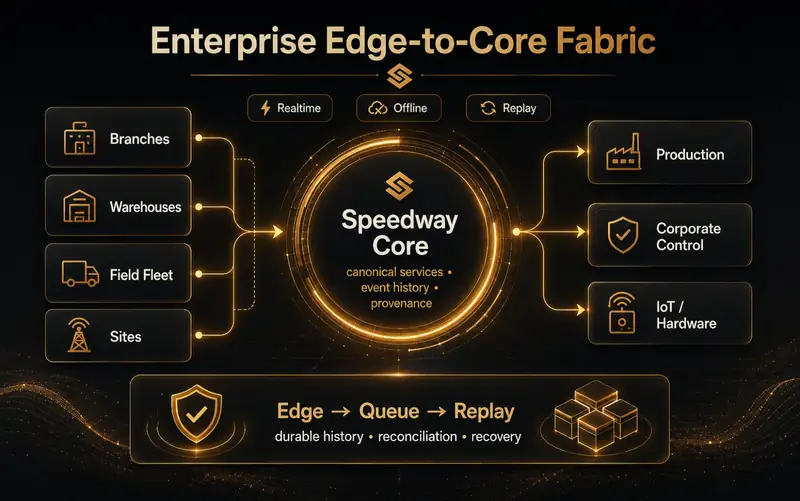
Architecture before modules
Connect the operation without creating another disconnected stack.
Enterprise Speedway is organised around common authority and capability contracts, so new channels, locations, devices and providers extend the operating model instead of creating parallel ledgers or duplicate business logic.
Orders, inventory, fulfilment, workforce, payments and evidence resolve through governed Speedway services rather than uncontrolled external writes.
Locations, teams, devices, roles and workflows can operate with scoped permissions while remaining connected to a shared operating record.
Speedway Edge supports bounded local execution, device identity, durable command journals, replay, acknowledgement and deterministic reconciliation.
Connect, scope, map, validate, preview, activate, observe and recover integrations through one governed control plane.
Fulfilment, routing, field work, tasks, SOP evidence and operational messaging can attach directly to the objects they affect.
Atlas can explain, detect anomalies, recommend and coordinate actions while protected operational services remain authoritative.
Staged enterprise adoption
Connect first. Consolidate as value is proven.
Speedway does not require an all-at-once replacement programme. Existing systems can participate at controlled boundaries while teams progressively move workflows onto the canonical operating layer.
Identify sites, systems, devices, data domains and workflows. Define identities, capability scopes and authority boundaries before activation.
Map external identifiers to canonical objects, exercise retries and reconciliation, and preview operational effects without bypassing Speedway authority.
Launch selected workflows, monitor health, lag, conflicts and evidence, then expand or consolidate when the operating model is proven.
Control and continuity
Design every external dependency to be replaceable.
The enterprise boundary is strongest when Speedway keeps the complete authoritative operational history even if a provider, device, channel or algorithm changes later.
Participants receive only the identities, capabilities and data access required for their role, tenant, site, device or workflow.
Commands, observations and events carry correlation, source and revision context so retries do not silently duplicate business effects.
Operational decisions, acknowledgements, receipts and workflow evidence can remain linked to the canonical objects they changed.
Health, lag, retry, offline and conflict states are observable so teams can recover deliberately rather than losing authority during outages.
Enterprise questions
What architecture and operations teams usually need to establish first.
Enterprise adoption starts with authority, continuity and integration boundaries—not a list of disconnected feature promises.
How does Speedway avoid becoming another enterprise data silo?
Speedway is designed around governed canonical services and one operating record. External systems, channels and devices participate through scoped contracts rather than writing directly into canonical state.
Can Speedway connect to existing enterprise systems and hardware?
Yes. Speedway is designed for staged integration. Existing systems, channels and devices can connect through governed capabilities while core authority, provenance, permissions and reconciliation remain under Speedway control.
What happens if a connected provider, channel or device becomes unavailable?
The architecture keeps provider and device specifics behind controlled boundaries. Speedway retains authoritative operational history and can use durable queues, retries, fallbacks and reconciliation according to the workflow involved.
How does Atlas AI operate in an enterprise environment?
Atlas works above the governed operating record to summarize, detect anomalies, recommend and coordinate actions within defined permissions and policy. Deterministic operational services remain authoritative for protected business state.
Plan the operating boundary