Speedway Integration Hub
Connect every operational participant without giving up one source of truth.
Speedway connects external systems, commerce channels, hardware, logistics, teams and AI through governed capability boundaries. Participants can observe, request and execute work, while canonical Speedway services retain authority over protected business state, provenance and operational history.
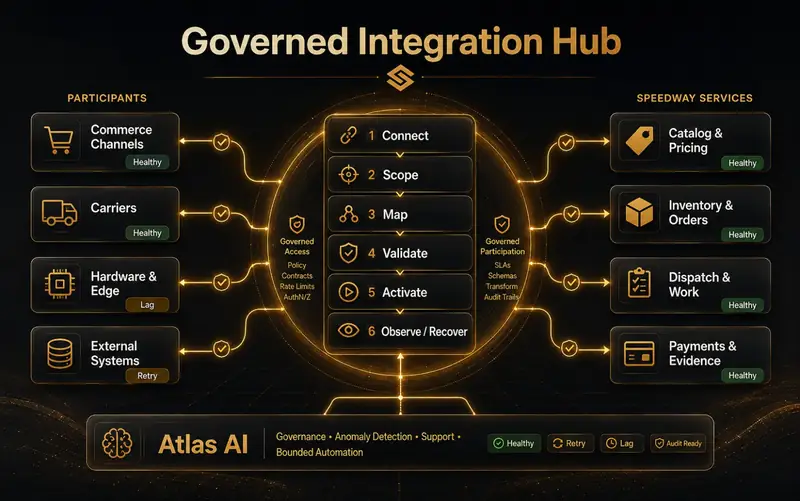
From external fact to governed outcome
Integration is a controlled operating flow, not uncontrolled two-way sync.
Speedway separates what an external participant sees or requests from the decision that changes canonical state. That boundary lets providers, devices and channels be replaced without rebuilding the core record.
A channel, device or system reports a fact it has seen, with source and revision context.
A participant requests an action using its granted identity, scope and capability.
The owning Speedway service validates policy and resolves the authoritative outcome.
The accepted business change becomes part of the governed operating history.
Approved state is exposed to apps, channels, search, devices or downstream workflows.
Execution acknowledgements, failures, retries and supporting evidence remain traceable to the affected object.
Integration lifecycle
Connect, prove and operate every integration through the same governed lifecycle.
The Integration Hub is designed as a common control plane so enterprise integrations do not each invent their own permissions, mapping, retry and recovery rules.
Identify the participant, tenant, sites, systems, devices and operational domains involved.
Grant only the capabilities and data boundaries required for that participant and workflow.
Associate external identifiers and revisions with canonical Speedway objects.
Exercise permissions, duplicate protection, retries, failure modes and reconciliation before activation.
Inspect intended operational effects before allowing a connector or device to influence live workflows.
Enable approved capabilities within the defined authority boundary.
Track health, lag, pending work, retries, conflicts, offline participants and evidence.
Retry, reconcile, suspend, replace or restore a participant without surrendering the canonical record.
Speedway Edge and offline-first operations
Connectivity can change. Operational authority should not disappear with it.
The Speedway fleet is designed to keep permitted local state usable, queue mutations for synchronization and resolve conflicts deliberately rather than forcing every user action to depend on an immediate remote API response.
Offline-capable records carry local and server revision context plus explicit sync states such as pending, synced, conflict or failed.
UI components create local mutations first; background synchronization handles remote delivery when connectivity permits.
Printing, scanning, camera, location, biometrics, files, notifications and network status are exposed through shared capability modules rather than app-specific assumptions.
Operational realtime delivery is paired with durable polling and server-sent-event fallback requirements so degraded transport does not silently remove continuity.
Hardware execution uses device identity, scoped capabilities, queued commands, retry state, receipts and audit evidence rather than treating a peripheral as trusted by default.
Reconnects can be reconciled against canonical revisions, with conflicts surfaced instead of silently overwriting authoritative state.
One platform, replaceable participants
Change a provider, channel or device without losing the business history around it.
Speedway keeps implementation-specific details behind controlled boundaries. The operational record remains useful even when the external participant changes.
External storefronts and marketplaces can project catalog, availability and orders through mappings to canonical objects.
Printers, scanners, RFID and other edge capabilities can participate through normalized capability contracts and evidence.
Carrier, fleet and routing services can quote, book, track and report outcomes while Speedway owns the fulfilment operating model.
Tasks, SOP evidence and operational conversations can attach to the order, incident, asset, delivery or workflow they affect.
External financial participants can remain replaceable while Speedway preserves its own order, payment and reconciliation history.
AI can reason over the governed record and coordinate permitted actions without becoming a parallel ledger or bypassing deterministic authority.
Architecture guardrails
The Integration Hub is powerful because it refuses shortcuts that create future lock-in.
The operating boundary is considered healthy when Speedway can retain complete authoritative history and replace a participant without redesigning the core record.
Connected participants do not become trusted writers to protected canonical tables or business state.
An integration may maintain projections or caches, but it should not create a competing source of truth for the same business object.
Connector-specific identifiers and capabilities stay at the boundary so the core operating model remains Speedway-owned.
Atlas can assist and coordinate within policy; orders, inventory, money and other protected state still resolve through deterministic authority.
Integration Hub questions
What enterprise and technical teams usually need to know first.
The goal is not to collect integrations. It is to connect them without fragmenting authority, evidence or continuity.
What is the Speedway Integration Hub?
The Speedway Integration Hub is the governed control plane for connecting systems, channels, devices and operational participants to Speedway. Connections use scoped identities, capabilities and reconciliation rather than direct writes into canonical business state.
What does one operating record mean?
One operating record means each protected business object has one canonical authority and durable operational history. Projections, caches, search indexes and external systems may exist, but they do not become competing sources of truth.
How does Speedway handle unstable or unavailable networks?
Speedway is designed offline-first. Local state remains usable where a workflow permits it, mutations are queued for synchronization, conflicts are handled deliberately, and realtime delivery is paired with durable fallback paths.
Can existing systems connect without an all-at-once replacement?
Yes. Speedway supports staged adoption: connect and scope participants, map canonical objects, validate behaviour, preview effects, activate selected workflows, observe health and recover deliberately before expanding.
Does Atlas AI become the authority for orders, money or inventory?
No. Atlas works above the governed operating record to explain, detect anomalies, recommend and coordinate actions within policy. Deterministic Speedway services remain authoritative for protected operational state.
Start at the highest-friction boundary